A size-by-size geometry profile with manufacturer provenance and RideDNA consistency-audit context. Use the complete table to compare fit and handling before opening the interactive tools.
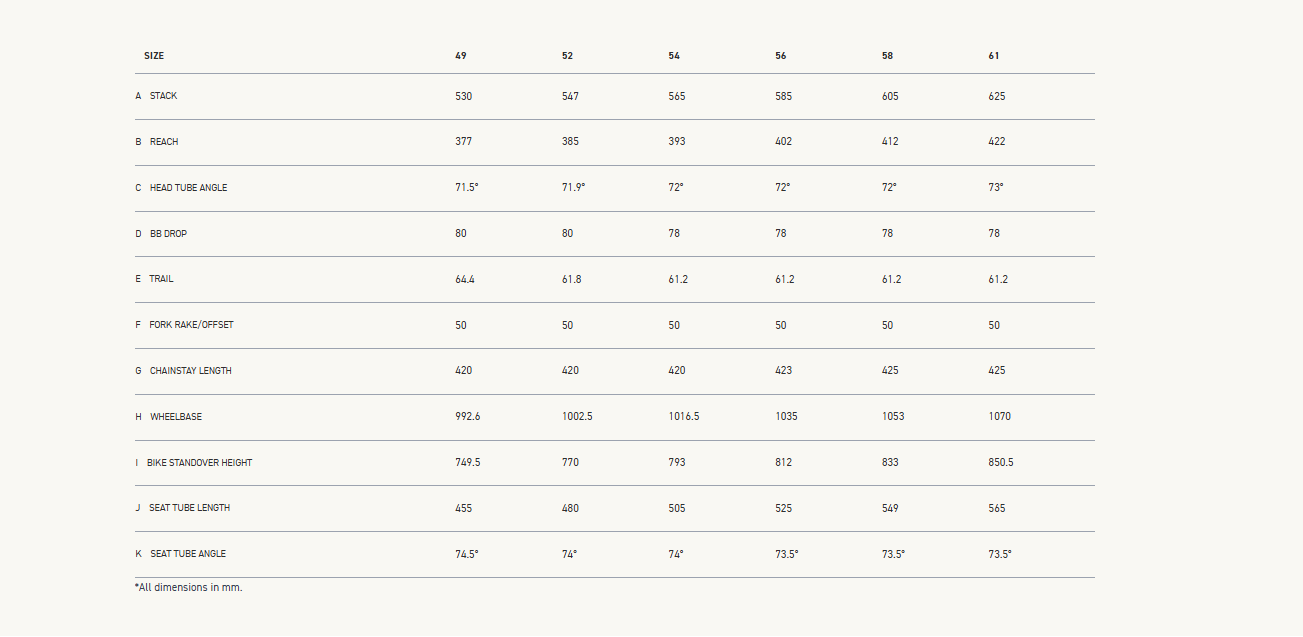
Source: Manufacturer geometry source
Provenance: published is present in the manufacturer data; derived is calculated by RideDNA; manual is a staff-entered reference rather than a manufacturer-chart value. “Not published” means the manufacturer did not provide a value for that size.
| Size | Stack | Reach | HTA | STA | ETT | Chainstay | Wheelbase | Front center | BB drop | Trail | Fork offset | Audit context |
|---|---|---|---|---|---|---|---|---|---|---|---|---|
| 49 | 530 mm published | 377 mm published | 71.5 ° derived | 74.5 ° derived | Not published | 420 mm derived | 993 mm published | 573 mm derived | 80 mm derived | 64.4 mm published | 50 mm published | red |
| 5 of 5 checks flagged — Stated Rₜ vs Implied Rₜ shows -8mm discrepancy | ||||||||||||
| 52 | 547 mm published | 385 mm published | 71.9 ° derived | 74.0 ° derived | Not published | 420 mm derived | 1003 mm published | 583 mm derived | 80 mm derived | 61.8 mm published | 50 mm published | red |
| 5 of 5 checks flagged — Stated Rₜ vs Implied Rₜ shows -8mm discrepancy | ||||||||||||
| 54 | 565 mm published | 393 mm published | 72.0 ° derived | 74.0 ° derived | Not published | 420 mm derived | 1015 mm published | 595 mm derived | 78 mm derived | 61.2 mm published | 50 mm published | red |
| 5 of 5 checks flagged — Stated Rₜ vs Implied Rₜ shows -7.8mm discrepancy | ||||||||||||
| 56 | 585 mm published | 402 mm published | 72.0 ° derived | 73.5 ° derived | Not published | 423 mm derived | 1035 mm published | 612 mm derived | 78 mm derived | 61.2 mm published | 50 mm published | red |
| 5 of 5 checks flagged — Stated Rₜ vs Implied Rₜ shows -7.8mm discrepancy | ||||||||||||
| 58 | 605 mm published | 412 mm published | 72.0 ° derived | 73.5 ° derived | Not published | 425 mm derived | 1053 mm published | 628 mm derived | 78 mm derived | 61.2 mm published | 50 mm published | red |
| 5 of 5 checks flagged — Stated Rₜ vs Implied Rₜ shows -7.8mm discrepancy | ||||||||||||
| 61 | 625 mm published | 422 mm published | 73.0 ° derived | 73.5 ° derived | Not published | 425 mm derived | 1070 mm published | 645 mm derived | 78 mm derived | 61.2 mm published | 50 mm published | red |
| 5 of 5 checks flagged — Stated Rₜ vs Implied Rₜ shows 13.2mm discrepancy | ||||||||||||
Overall consistency: red. This context is shown alongside the table so a rider can distinguish a complete published specification from a value that RideDNA had to derive or could not independently verify.
The Factor Aluto geometry audit is severely compromised by the manufacturer's decision to withhold fork axle-to-crown length, head tube length, and effective top tube length. The engine derived ETT from the published reach, stack, and seat tube angle values using the formula ETT = Reach + Stack / tan(STA°), which renders the reach reconciliation check algebraically circular — it confirms formula consistency only, not independent verification of the published reach. The wheelbase check cannot be performed for two reasons: the manufacturer has not published wheelbase values, and even if they had, the engine's computed wheelbase is anchored to the derived ETT, so comparing two ETT-derived values would not constitute meaningful independent verification. By withholding fork axle-to-crown length, head tube length, and effective top tube length, the manufacturer prevents independent scrutiny of its geometry claims and denies consumers the data they need to evaluate handling characteristics or make meaningful comparisons with competing models. These are not obscure technical figures — they are standard dimensions routinely published by competing manufacturers. This is a deliberate choice, not a technical limitation. Consumers cannot fully assess fit, predict handling, or compare this bicycle on equal terms without it. Transparency about geometry is not optional: it is the minimum standard a manufacturer owes to buyers making thousands-of-dollars purchasing decisions.