A size-by-size geometry profile with manufacturer provenance and RideDNA consistency-audit context. Use the complete table to compare fit and handling before opening the interactive tools.
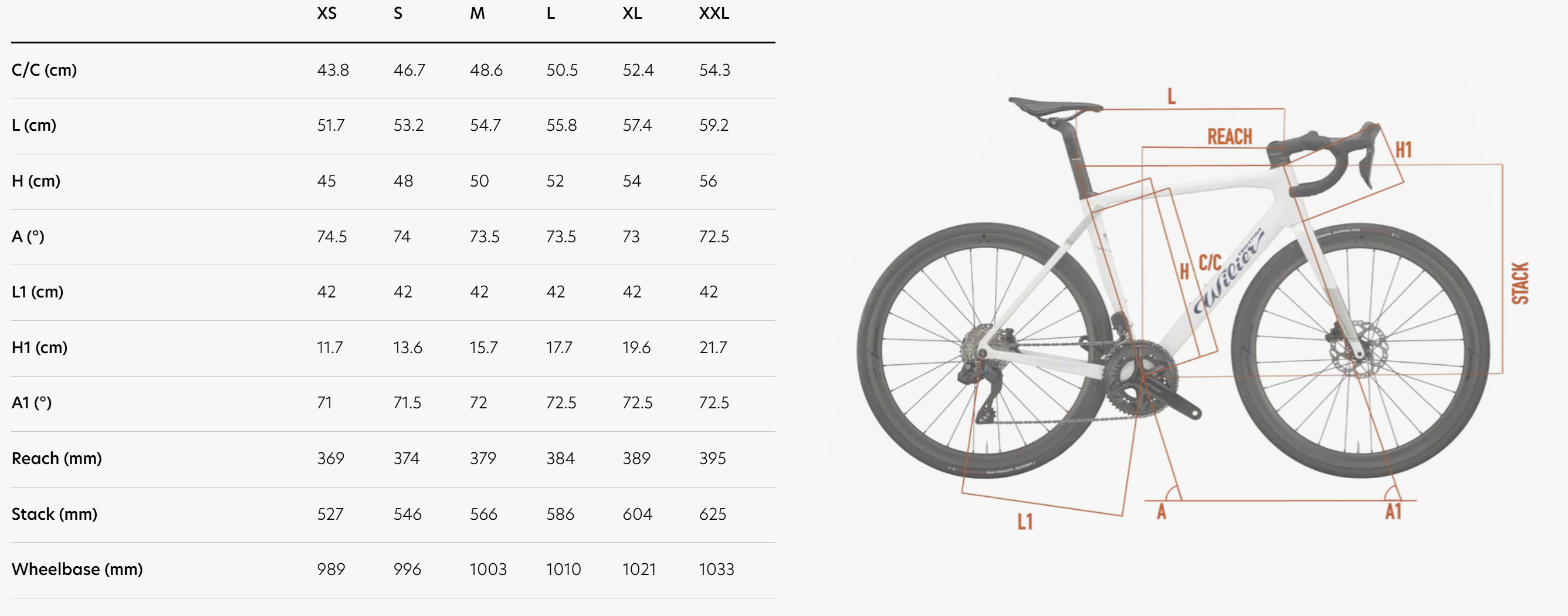
Source: Manufacturer geometry source
Provenance: published is present in the manufacturer data; derived is calculated by RideDNA; manual is a staff-entered reference rather than a manufacturer-chart value. “Not published” means the manufacturer did not provide a value for that size.
| Size | Stack | Reach | HTA | STA | ETT | Chainstay | Wheelbase | Front center | BB drop | Trail | Fork offset | Audit context |
|---|---|---|---|---|---|---|---|---|---|---|---|---|
| L | 586 mm published | 384 mm published | 72.5 ° derived | 73.5 ° derived | 558 mm derived | 420 mm derived | 1010 mm published | Not published | Not published | Not published | Not published | purple |
| 3 of 3 checks could not be independently verified — manufacturer did not publish the required geometry | ||||||||||||
| M | 566 mm published | 379 mm published | 72.0 ° derived | 73.5 ° derived | 547 mm derived | 420 mm derived | 1003 mm published | Not published | Not published | Not published | Not published | purple |
| 3 of 3 checks could not be independently verified — manufacturer did not publish the required geometry | ||||||||||||
| S | 546 mm published | 374 mm published | 71.5 ° derived | 74.0 ° derived | 532 mm derived | 420 mm derived | 996 mm published | Not published | Not published | Not published | Not published | purple |
| 3 of 3 checks could not be independently verified — manufacturer did not publish the required geometry | ||||||||||||
| XL | 604 mm published | 389 mm published | 72.5 ° derived | 73.0 ° derived | 574 mm derived | 420 mm derived | 1021 mm published | Not published | Not published | Not published | Not published | purple |
| 3 of 3 checks could not be independently verified — manufacturer did not publish the required geometry | ||||||||||||
| XS | 527 mm published | 369 mm published | 71.0 ° derived | 74.5 ° derived | 517 mm derived | 420 mm derived | 989 mm published | Not published | Not published | Not published | Not published | purple |
| 3 of 3 checks could not be independently verified — manufacturer did not publish the required geometry | ||||||||||||
| XXL | 625 mm published | 395 mm published | 72.5 ° derived | 72.5 ° derived | 592 mm derived | 420 mm derived | 1033 mm published | Not published | Not published | Not published | Not published | purple |
| 3 of 3 checks could not be independently verified — manufacturer did not publish the required geometry | ||||||||||||
Overall consistency: purple. This context is shown alongside the table so a rider can distinguish a complete published specification from a value that RideDNA had to derive or could not independently verify.
The Wilier Granturismo SL specification is deliberately incomplete — the manufacturer has withheld fork offset, fork axle-to-crown length (A2C), BB drop, front center, and trail. Front center and trail cannot be determined because all three core fork dimensions (offset, A2C, BB drop) are simultaneously withheld, blocking any back-calculation path. The stack, reach, and wheelbase checks show 0.0mm deltas across all six sizes, but these are trivial passes — the engine carried through the published values because the withheld dimensions prevent independent geometric calculation. These results do not constitute genuine verification of the manufacturer's published geometry. The specification also exhibits unusual angle progression patterns: head tube angle steps down 1.5° from XXL to XS (72.5° → 71°), and seat tube angle shows large jumps between L and XXL (−1.0°) and XXL to XS (+2.0°) — patterns that warrant verification of the source data, though the root cause cannot be determined from the published geometry data alone. By omitting these 5 dimensions, the manufacturer prevents independent scrutiny of its geometry claims and denies consumers the data they need to evaluate handling characteristics or make meaningful comparisons with competing models. These are not obscure technical figures — they are standard dimensions routinely published by competing manufacturers. This is a deliberate choice, not a technical limitation — the manufacturer possesses this information and has elected not to share it. Consumers cannot assess fit, predict handling, or compare this bicycle on equal terms without it. Transparency about geometry is not optional: it is the minimum standard a manufacturer owes to buyers making thousands-of-dollars purchasing decisions.