Filtered against every manufacturer's published rider-height range. 11 bikes in the audited catalog list 185 cm inside their official fit window.
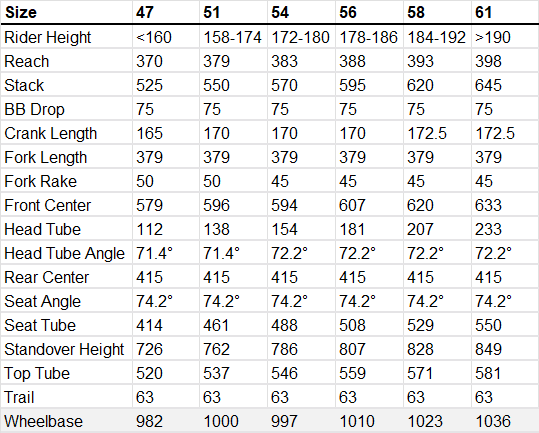
| Bike | Manufacturer fit range | Stack | Reach |
|---|---|---|---|
| BMC RoadMachine 2026 | 158 cm – 192 cm | 582 mm | 388 mm |
| BMC TeamMachine 2026 | 166 cm – 192 cm | 557 mm | 392 mm |
| Winspace T1600 2026 | 155 cm – 192 cm | 523 mm | 382 mm |
| Giant Defy Advanced 2026 | 160 cm – 198 cm | 567 mm | 382 mm |
| Bike | Manufacturer fit range | Stack | Reach |
|---|---|---|---|
| Lauf Seigla 2026 | 156 cm – 200 cm | 565 mm | 388 mm |
| Santa Cruz Stigmata 2026 | 152 cm – 193 cm | 588 mm | 412 mm |
| BMC URS 2026 | 165 cm – 188 cm | 580 mm | 410 mm |
| 3T Racemax 2 Italia 2026 | 157 cm – 195 cm | 579 mm | 379 mm |
| BMC Kaius 2026 | 166 cm – 192 cm | 561 mm | 402 mm |
| 3T Extrema Italia 2026 | 157 cm – 195 cm | 580 mm | 382 mm |
| 3T Ultra 700c 2026 | 145 cm – 210 cm | 574 mm | 387 mm |
At 185 cm you sit inside the published fit window of 11 bikes (4 Road, 7 Gravel). That is more options than most riders realise — the manufacturer fit ranges are deliberately conservative on both ends, which means a bike whose top size lists you at its upper boundary is not "too big", just at the upper end of its design intent.
Two cohorts inside this list deserve closer attention. 0 bikes list 185 cm within 2 cm of the bottom of their range — meaning you would be on the smaller end of the size, which favours an aggressive fit, more standover clearance, and easier handling at the cost of cockpit length. 0 bikes list 185 cm within 2 cm of the top of their range — meaning you would be on the larger end, which favours a longer cockpit and more stability at the cost of standover and quick weight-shifting.
Manufacturer fit ranges are not interchangeable across brands. Two bikes that both list "175 cm" can have stack values 25 mm apart and reach values 15 mm apart — comparable to swapping a 70 mm stem for a 100 mm stem. The Stack and Reach columns above are the columns to read carefully. As a rough heuristic, riders of the same height usually settle on bikes whose stack is within ±10 mm of each other across categories; a bike that's 30 mm shorter or taller than your current one will feel materially different even if both manufacturers say it fits you.
Once you've narrowed the list, the comparison tool can put any two bikes from the table above side-by-side with full geometry. If you already own a bike you like, the Fit Wizard takes its measurements as a baseline and ranks the candidates by how closely they match your current cockpit, rather than by manufacturer marketing copy. And if you want to slice the same data by riding style instead of by height, jump into the XC, gravel, all-road or road-race pages.
One number to ignore: the manufacturer-published "size" (S/M/L or 52/54/56). Letter-sizes are not standardised between brands and number-sizes are usually a seat-tube length, which is the least informative geometry value on the chart. Stack and reach are what locate the cockpit; standover clearance is what tells you whether you can put a foot down. The columns above give you those numbers up front so you don't have to dig.