2026 · Airborne · Road
Zeppelin MK-V frame guide
First introduced in the late 1990s, the original Zeppelin established a reputation as one of the finest titanium road bicycles of its time. Among the earliest direct-to-consumer titanium frames, it was admired for its refined ride quality, compliance, and exceptional durability — qualities that continue to be appreciated by discerning riders today.
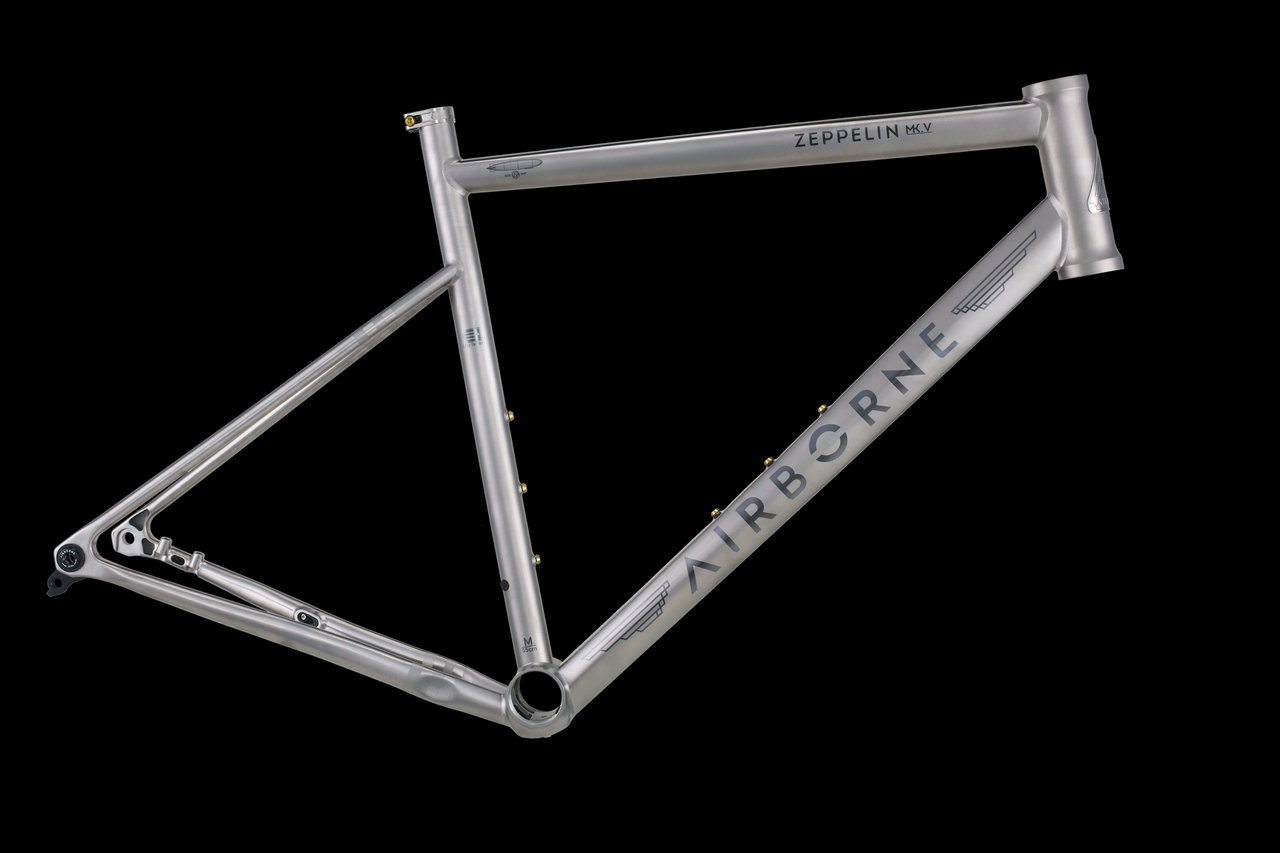
The Zeppelin MK5 advances this foundation with contemporary capability. Sharing the identical front triangle as the MK4 and maintaining near-identical geometry, it is designed for riders who require greater versatility and modern braking performance without compromise.
What can be adjusted?
Fixed headset and dropout/track.
Exploring a frame in RideDNA does not imply adjustable frame hardware. Tire and compatible fork choices can be studied in software, but the frame’s headset and dropout capabilities remain those listed above. Confirm fork compatibility and physical tire clearance with Airborne before changing components.
Frame features
Key features:
UDH-compatible disc brake dropouts — confident, consistent stopping power and future-proof compatibility
Clearance for tires up to 38 mm — expanded range for varied surfaces and conditions
Premium double-butted 3Al-2.5V titanium tubing construction — natural compliance, superior vibration damping, and lifetime durability.
Advanced hydroformed titanium T/T and D/T — precisely engineered shapes for superior stiffness where you need it, compliance where you want it, and a strikingly modern, aggressive aesthetic.
SLM 3D Printed Grade 5 (6Al/4V) Titanium, Vacuum Annealed frame components:
UDH Dropouts
Integrated T47 BB
Modern endurance-oriented geometry — composed handling, efficient power transfer, and all-day comfort
For riders seeking the refined character of the Zeppelin with disc braking confidence and increased tire clearance, the MK5 offers a purposeful, forward-looking evolution.
Recorded frame geometry
Values below come directly from this Airborne model’s size records, including CAD reference stack, reach and wheelbase where recorded. Angles and BB drop use the size-specific value, falling back to the model baseline. Values are not an engine-generated setup or a guarantee of comparison eligibility. Missing measurements remain “Not recorded.”
| Size | Stack | Reach | Effective top tube | Head angle | Seat angle | Head tube | Wheelbase | BB drop |
|---|---|---|---|---|---|---|---|---|
| XS | 46.5cm | 526.1 mm | 358.1 mm | 505 mm | 70° | 74.4° | 119 mm | 981.4 mm | 77 mm |
| S | 50cm | 532.6 mm | 365.4 mm | 518.1 mm | 70.5° | 74° | 124 mm | 986.4 mm | 77 mm |
| M | 53cm | 549.5 mm | 379.4 mm | 540.1 mm | 71.5° | 73.7° | 138 mm | 996.9 mm | 77 mm |
| XM | 55cm | 578.9 mm | 383 mm | 555.6 mm | 72° | 73.4° | 167 mm | 1005.3 mm | 77 mm |
| L | 57.5cm | 592.3 mm | 390.8 mm | 571.9 mm | 72.8° | 73° | 178 mm | 1009.3 mm | 77 mm |
| XL | 59.5cm | 622.5 mm | 395.3 mm | 592.8 mm | 73° | 72.4° | 214 mm | 1023.5 mm | 72 mm |
| XXL | 62cm | 660.7 mm | 403.8 mm | 618.5 mm | 73° | 72° | 254 mm | 1043.7 mm | 72 mm |
Read before choosing components
Understand stack and reach · Understand fork offset and trail · Compare gravel geometry
The interactive overview contains the existing geometry, photo and component navigation. Purchase links remain on Airborne’s store; this guide does not create an order.