Mechanical trail is the horizontal distance between the steering-axis ground contact and the front-tyre contact patch. It is the dominant geometric driver of self-centring and front-wheel feedback.
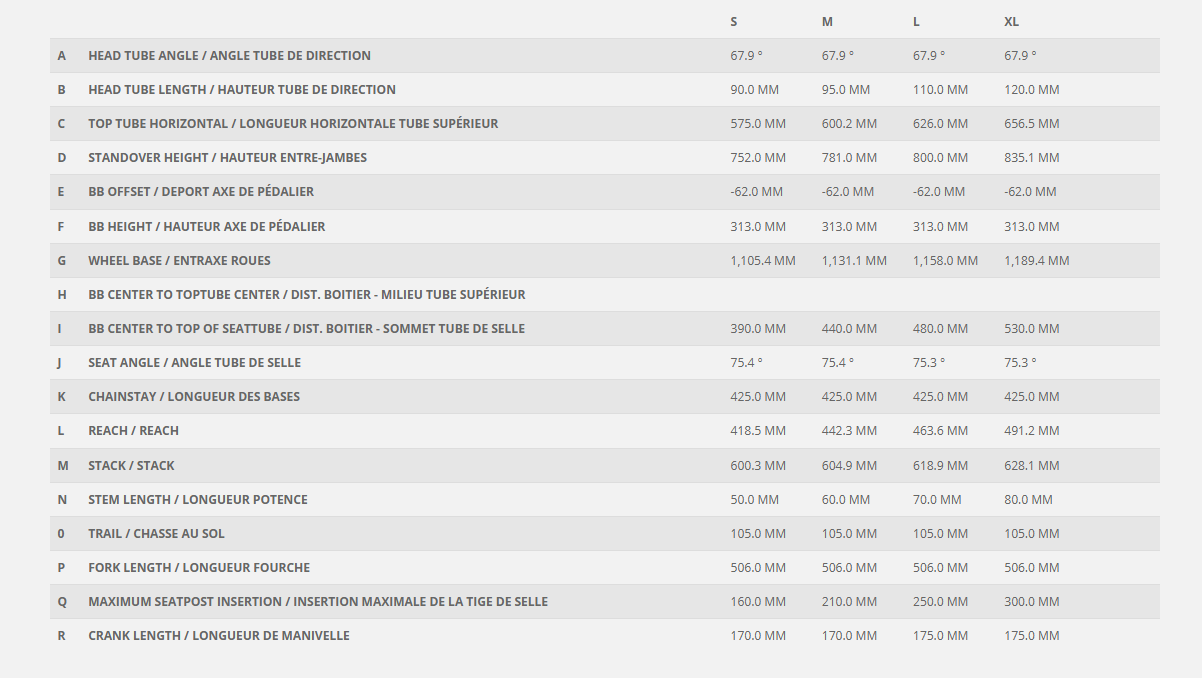
| # | Bike | Mechanical Trail | Type |
|---|---|---|---|
| 1 | Scott Scale Gravel RC 2026 | 103 mm | Gravel |
| 2 | Salsa Cutthroat C 2026 | 87 mm | Gravel |
| 3 | Parlee Taos 2026 | 87 mm | Gravel |
| 4 | BMC URS 2026 | 85 mm | Gravel |
| 5 | Santa Cruz Stigmata 2026 | 85 mm | Gravel |
| 6 | Orbea Terra 2026 | 82 mm | Gravel |
| 7 | Niner ORE 9 RDO 2026 | 81 mm | Gravel |
| 8 | Lauf Seigla 2026 | 78 mm | Gravel |
| 9 | Moots Routt RSL 2026 | 78 mm | Gravel |
| 10 | Niner RLT 9 RDO 2026 | 73 mm | Gravel |
| # | Bike | Mechanical Trail | Type |
|---|---|---|---|
| 1 | Giant Defy Advanced 2026 | 56 mm | Road |
| 2 | Pinarello Dogma F 2026 | 56 mm | Road |
| 3 | Cannondale SuperSix EVO 2026 | 58 mm | Road |
| 4 | Cervelo Caledonia 2026 | 59 mm | Road |
| 5 | ENVE Fray 2026 | 59 mm | Road |
| 6 | Scott Addict RC 2026 | 60 mm | Road |
| 7 | Trek Domane SLR Gen 4 2026 | 60 mm | Road |
| 8 | Airborne Zeppelin MK IV 2026 | 61 mm | Road |
| 9 | Cannondale Synapse Carbon 2026 | 61 mm | Road |
| 10 | Factor Aluto 2026 | 61 mm | Gravel |
Across 52 audited models the Mechanical Trail ranges from 56 mm to 103 mm, with a mean of 68 mm and a median of 65 mm. The mean and median agree closely, which tells you the catalog is not skewed toward an extreme of the distribution — most modern bikes target the middle, and the leaderboard above lets you see who deliberately steps outside it.
The current high-watermark is the Scott Scale Gravel RC 2026; the current floor is the Giant Defy Advanced 2026. More trail produces calm, self-centring steering — preferred for descents, loaded touring, and long gravel days. Less trail produces light, responsive steering — preferred for crit racing, technical XC, and trials-style handling.
| Type | n | Min | Mean | Max |
|---|---|---|---|---|
| Gravel | 34 | 61 mm | 71 mm | 103 mm |
| Road | 18 | 56 mm | 61 mm | 70 mm |
This per-discipline breakdown is the more honest comparison: comparing an XC hardtail's Mechanical Trail to a road frame's is a category error. Use the type rows to find the right peer group, then drill into individual bikes from the leaderboards above. Each bike row links straight to its full geometry page on RideDNA, where you can run a side-by-side against any other audited frame.
If you want to filter on multiple metrics at once, the filter tool lets you set ranges on stack, reach, HTA, trail, wheelbase and chainstay simultaneously and returns every bike that satisfies all the constraints. The discipline pages apply pre-baked filters by riding style, which is the fastest way in if you already know what you ride.
Caveat. Published geometry charts are not all drawn the same way. Some manufacturers publish stack at the top of the head tube exclusive of any integrated headset cap; others publish it at the top of the cap. RideDNA reconciles these to a common reference where possible (see the methodology page for the corrections we apply), but for any single bike you should still treat the chart as ±2 mm uncertainty before you stack-spacer-shop. The relative ordering on this page is more reliable than the absolute values.