Ranked by Euclidean distance across stack, reach, head-tube angle, mechanical trail, chainstay length, wheelbase, and bottom-bracket drop — all z-scaled so no metric dominates.
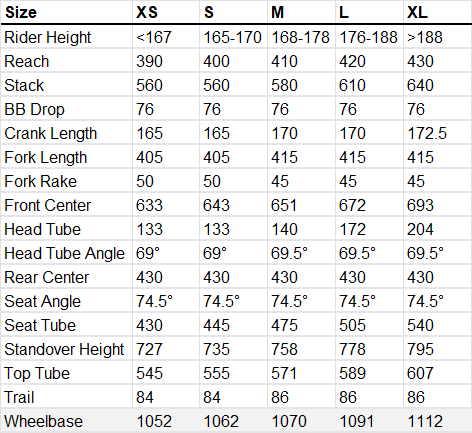
| Stack | 580 mm | Reach | 410 mm |
|---|---|---|---|
| Head-tube angle | 69.5 ° | Trail | 85.1 mm |
| Chainstay | 430 mm | Wheelbase | 1070 mm |
| BB drop | 76 mm | Type | Gravel |
| # | Bike | Δ | Stack | Reach | HTA | Trail | WB |
|---|---|---|---|---|---|---|---|
| 1 | Santa Cruz Stigmata 2026 | 0.61 | 588 mm | 412 mm | 69.5 ° | 85.0 mm | 1075 mm |
| 2 | Parlee Taos 2026 | 1.72 | 595 mm | 396 mm | 69.5 ° | 86.9 mm | 1059 mm |
| 3 | Orbea Terra 2026 | 1.82 | 591 mm | 398 mm | 70.3 ° | 81.8 mm | 1051 mm |
| 4 | Niner ORE 9 RDO 2026 | 1.86 | 588 mm | 409 mm | 69.0 ° | 81.2 mm | 1091 mm |
| 5 | Salsa Flyway C 2026 | 2.32 | 580 mm | 399 mm | 70.5 ° | 70.9 mm | 1049 mm |
| 6 | Allied Able 2026 | 2.86 | 565 mm | 397 mm | 70.5 ° | 67.7 mm | 1055 mm |
| 7 | Pinarello Granger 2026 | 2.86 | 581 mm | 387 mm | 70.6 ° | 72.1 mm | 1041 mm |
| 8 | Pivot Vault (Rigid) 2026 | 2.93 | 579 mm | 398 mm | 70.6 ° | 68.8 mm | 1044 mm |
Across the 8 closest matches in the catalog the BMC URS 2026 fits a recognisable cluster of Gravel bikes. The neighbour set was selected only from the same bike-type bucket and only from models for which we have a full stack/reach/HTA/trail/chainstay/wheelbase/BB-drop record — so the distance numbers above are like-for-like, not apples-to-oranges.
The single closest geometric match is the Santa Cruz Stigmata 2026, with a normalised distance of 8.0 mm of stack and 2.3 mm of reach separating the two. Riders who liked the position of one will almost always feel at home on the other.
BMC URS 2026 runs about 3.4 mm less stack than the median of its closest neighbours, so this is the more aggressive pick of the cluster — better for race fits, lower bar drops, and riders who want their stem closer to the steerer-tube cap.
BMC URS 2026 runs about 10.7 mm more reach than the median of its closest neighbours, so the cockpit is longer than its peers, which usually pairs well with a shorter stem and suits taller torsos.
BMC URS 2026 runs about 8.3 mm more trail than the median of its closest neighbours, so the steering is calmer and more self-centring than its peers — better for descents, loaded riding, and high-speed gravel.
Use the side-by-side comparison links below to drill in on any specific pairing. Every comparison page on RideDNA is computed from the same audited geometry tables that power this list, so the numbers will be internally consistent. If you'd rather start from your existing fit, the Fit Wizard takes a few of your current bike's measurements and re-runs this same nearest-neighbour search from your seat, not from a brand the manufacturer chose to compete with.
Method. Each of the seven metrics is z-scaled by its standard deviation across the candidate pool before being summed in the Euclidean norm. This avoids wheelbase (typically ±50 mm of variation) drowning out HTA (±2° of variation). We deliberately do not include subjective scores in this similarity calculation — the goal is geometric kinship, not handling kinship. Two bikes that share geometry but pair it with very different fork offsets or tyre clearances can still feel different on the trail; the Handling Index page is the better tool for that question.